

For senior industry leaders, pursuing a doctoral degree while managing a demanding career is a significant decision. For Huang Donghao, Vice President of R&D and Global Emerging Technologies Lead at Mastercard, the Doctor of Engineering (EngD) programme at the Singapore Management University (SMU), School of Computing and Information Systems (SCIS) provided a structured way to deepen his technical expertise while continuing to drive innovation in a rapidly evolving technology landscape. As a recipient of the IMDA Singapore Digital Scholarship (Postgraduate), he has spent the past several years working at the intersection of enterprise systems, AI research, and emerging technologies.
Donghao’s academic and professional trajectory reflects a consistent interest in applied technology and scientific thinking. His academic journey began with a Bachelor of Engineering in Engineering Physics at Tsinghua University, followed by a Master of Science in Theoretical Physics at Peking University, where he published research in top-tier physics journals. Later, he completed a Master of Technology in Software Engineering at the National University of Singapore, bridging scientific fundamentals with practical software development.
Over the past 26 years, he has worked across multiple technology domains, from semiconductor systems to streaming technologies and, for the last 17 years, payments and commerce. Since joining Mastercard in 2011, he has held leadership roles in R&D and emerging technology strategy. Today, he oversees global initiatives in AI, generative AI, machine learning, and Web3, with teams distributed across regions.
The launch of ChatGPT in November 2022 marked a pivotal moment: “Recognising generative AI as a transformative force that would reshape not just technology but entire industries, I decided to pursue the EngD to deepen my technical expertise and contribute academically to this emerging field,” he explains.
He enrolled in the programme in August 2023 and is now in his final year.
Why the EngD Made Sense for a Working Professional
The EngD’s emphasis on industry-relevant research was a key factor in his decision. Unlike traditional PhD programmes, the EngD is designed for professionals who want research that translates into enterprise solutions.
“I was drawn to the EngD because it supports the kind of work I’ve focused on throughout my career: bridging advanced technologies with practical, high-impact applications,” he says.
SMU SCIS’ strong AI and Natural Language Processing (NLP) research ecosystem, combined with the opportunity to be supervised by Professor Wang Zhaoxia, was another decisive factor. Her expertise in sentiment analysis, explainability, and language models directly aligned with his professional interests in applying AI to financial services. Being awarded the SG Digital Scholarship further strengthened his commitment to research that supports Singapore’s digital capabilities.
Research Grounded in Enterprise Constraints
Donghao’s EngD research focuses on Generative AI and Large Language Models, with particular attention to their deployment in regulated, resource-constrained, and security-critical environments. His work covers several key areas:
- Model performance and efficiency
Improving LLM performance and efficiency on edge devices and resource-limited hardware, enabling AI deployment where cloud solutions are impractical or prohibited due to data residency requirements. - Explainability and trust
Enhancing explainability and trustworthiness in sentiment analysis and reasoning tasks, ensuring AI decisions can be understood, validated, and trusted by human stakeholders, is critical for regulatory compliance in financial services. - Improved evaluation frameworks
Developing comprehensive evaluation metrics and architectures for safer, more robust AI systems. This includes Donghao’s work on the RAP (Repetition-Aware Performance) metric, which addresses text repetition issues in open-source LLMs—a problem that impacts both user experience and operational reliability. - Multi-agent architectures for enterprise workflows
Designing and implementing multi-agent systems powered by LLMs for real-world enterprise use cases, including conversational commerce, invoice reconciliation, and automated compliance workflows. - Practical Deployment
Bridging the gap between academic benchmarks and production requirements by addressing operational concerns such as latency, cost, reliability, and scalability.
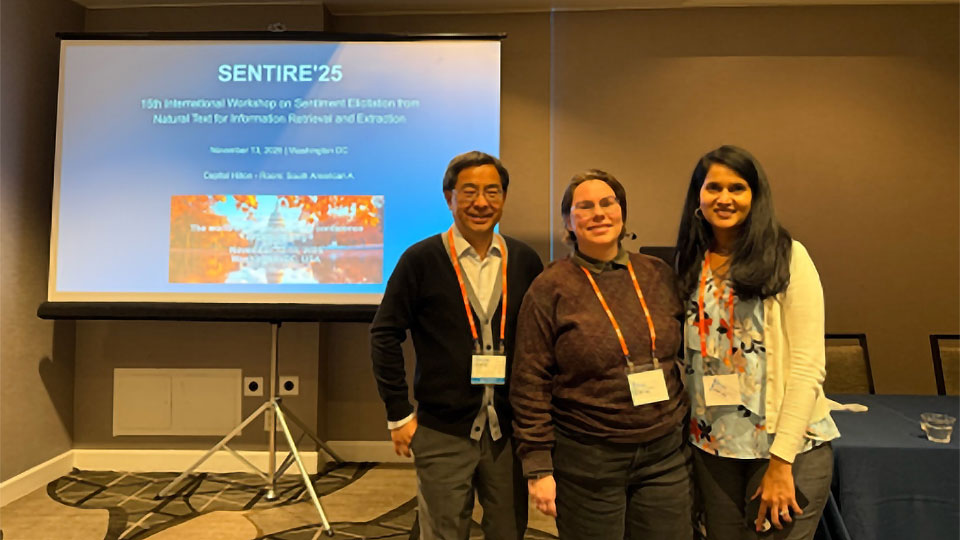
To date, Donghao has published 16 research papers and presented or accepted at international conferences including AAAI, NAACL, PAKDD, IJCNN, IEEE CAI, and ICDM. In 2025, he chaired the IEEE ICDM SENTIRE workshop on Sentiment Elicitation from Natural Text for Information Retrieval and Extraction. SENTIRE is a longstanding forum for sentiment analysis research.
![[Left to right: Huang Donghao, Erin Deutschman and Aparna Chekuru]](https://computing.smu.edu.sg/sites/scis.smu.edu.sg/files/community-stories/2026-02/featured-image.jpg)
A defining aspect of Donghao’s EngD experience has been the close connection between his research and the practical constraints of enterprise systems. Several of his research prototypes, including multi-agent systems and edge-deployed LLM frameworks, were designed with real-world requirements in mind and subsequently adopted at Mastercard.
Navigating the Realities of a Working Doctorate
Balancing a demanding global leadership role with doctoral research has been one of the most challenging aspects of the journey. Over the last three years, Donghao managed distributed teams across time zones. He relocated to the United States in 2025 and still had to dedicate significant time to research, study, and conference presentations.
He attributes his ability to stay on track to a disciplined approach: “I treat the EngD the same way I manage R&D projects — clear milestones, structured goals, and consistent execution.”
The flexibility of SMU SCIS has allowed him to complete his final year remotely helped greatly. Not to mention, having strong support from family, colleagues, and my supervisor makes the balance possible. Professor Wang Zhaoxia's guidance and understanding, combined with Mastercard's support for his academic pursuits, have created an ecosystem where excellence in both domains is achievable.
Looking Ahead: Agentic AI and Continued Collaboration
Following the completion of his EngD programme in April 2026, Donghao plans to continue exploring agentic AI — particularly multi-agent systems and their applications in financial services and conversational commerce. His existing portfolio of 10 granted patents and over 50 pending applications reflects an ongoing interest in creating practical intellectual property grounded in applied research.
Beyond his corporate work, he hopes to contribute through mentorship and potential adjunct teaching opportunities, especially in areas where AI intersects with financial services and enterprise deployment.
Advice for Prospective EngD Candidates
For professionals considering the EngD, Donghao offers several points of advice:
- Choose a research topic that aligns with your long-term interests. Multi-year research requires sustained focus.
- Build a strong relationship with your supervisor. Early alignment on scope and methods accelerates progress.
- Apply your industry experience. Practical understanding helps identify research gaps and design meaningful experiments.
- Aim for high-quality publications early and present at conferences. This not only validates your research but also builds your professional network
- Treat the programme as a structured project. Clear goals and habits make the workload more manageable.
“The EngD is demanding,” he says, “but it provides a rare opportunity to contribute academically while staying closely connected to industry practice.”