
Research Focus Areas
As a computing school in Singapore Management University, our research is uniquely defined by the twin emphasis of Academic Scholarship in Computing Technology and Practice Scholarship in Solution Development.
Our Academic Scholarships are directed to 3 selected areas, mainly Artificial Intelligence and Data Science, Human-Machine Collaborative Systems, and Information Systems and Technology.
At the same time, we need to go beyond technology creation in order to achieve practical impact.
We emphasise solution development which entails integrating different technologies, integrating with business models and processes, addressing usability, deployment and product management concerns, aligning with local ethical norms as well as legal and regulatory frameworks and ultimately, fulfilling user and organisational needs.
That is what we mean by Practice Scholarship.
The application areas that we direct our Practice Scholarship to are: Learning & Work, Urban & Sustainability, Health & Wellbeing, and Safety, Security & Fairness.
CORE RESEARCH AREAS
Create Computing Technology and Systems
Artificial Intelligence & Data Science



Human-Machine Collaborative Systems
Information Systems & Technology


INTEGRATIVE RESEARCH AREAS
Digital Transformation in Action
Learning & Work
- Future of Work
- Next Generation IT Practices

Urban & Sustainability
- Urban Mobility & Smart Environment
- Urban Logistics & Sustainability
- Crowd Management
- Homeland Security
Health & Well-being
- Ageing & Mental Health
- Biomedical Informatics
- Lifestyle & Wellness
- Social Analytics
Safety, Security & Fairness
- Trustworthiness of Digital Platforms & Devices
- Misinformation & Disinformation
- Privacy-Preserving Data Sharing & Analytics
- Security & Governance of Software/AI Systems
Centres, Labs & Initiatives

Formally known as Secure Mobile Centre, the Centre on Security, Mobile Applications and Cryptography conducts research on the following areas:
- Systems and mobile security
- Software and data security
- Cryptography and cloud security
- Digital platforms device security
- Program analysis and blockchain

Research Programmes
- Collaborative, Robust and Explainable AI-based Decision Making Lab
- Fujitsu-SMU Urban Computing & Engineering (UNiCEN) Corp. Lab
- Living Analytics Research Centre
- LiveLabs Urban Lifestyle Innovation Platform
- Pinnacle Lab
- SMU-A*STAR Joint Lab in Social and Human-Centered Computing
Practice and Outreach Programmes
Research Awards and Achievements
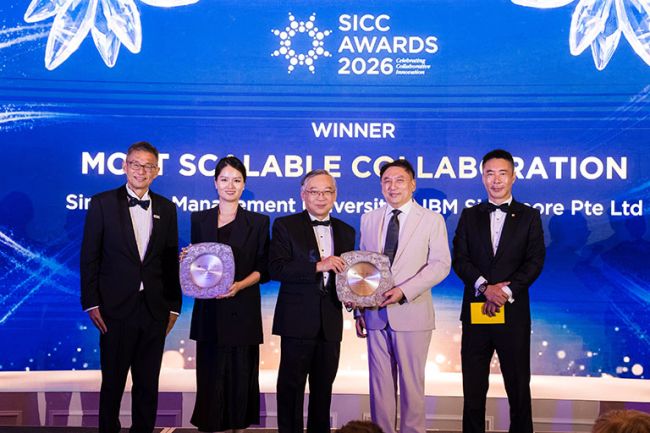
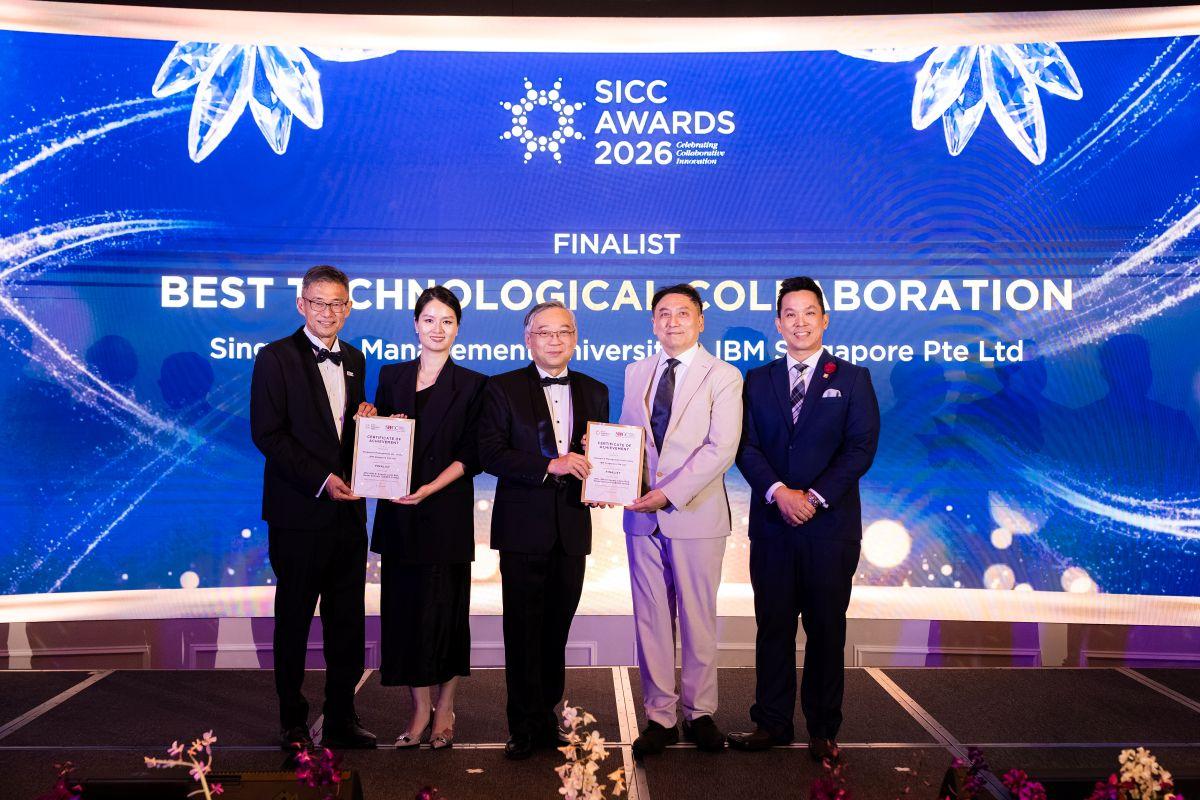
as Principal Investigator from SMU and IBM team member, representing SMU and IBM teams respectively, at the 2026 SICC Awards, for the “SMU-IBM AI Supply Chain Risk Model Delivers US$35M Saving by Singapore Management University and IBM Singapore Pte Ltd” collaboration.
Launched in 2015, the Singapore International Chamber of Commerce (SICC) Awards are built on the conviction that collaboration is very often the quickest way for companies, from all sectors and of all sizes, to innovate, grow and sustain themselves.
Senior Area Chairs (SAC) Highlights

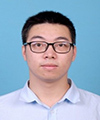

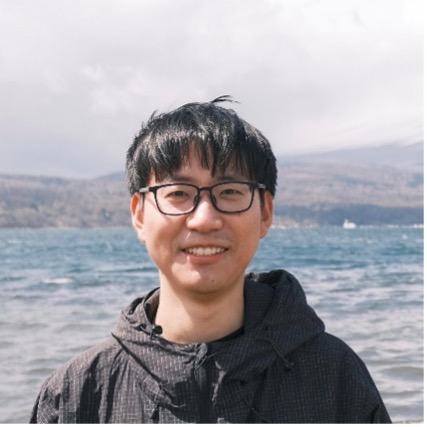
at the 64th Annual Meeting of the Association for Computational Linguistics (ACL 2026), for the paper, "SeCuRepair: Semantics-Aligned, Curriculum-Driven, and Reasoning-Enhanced Vulnerability Repair Framework".
The SAC Highlight is an award given by the Senior Area Chairs to recognize one or a small number of papers from their area that they consider particularly outstanding. Selected papers exemplify qualities such as originality, significance, technical excellence, reproducibility, or potential positive impact on the field. Typically, the award is given to less than 1% of all submissions. These papers are independent of the Best Paper Committee's selection.
Best Themed Paper
at the 64th Annual Meeting of the Association for Computational Linguistics (ACL 2026), for the paper, "CoSToM: Causal-oriented Steering for Intrinsic Theory-of-Mind Alignment in Large Language Models".
Best Themed Paper Award recognizes the best paper within the conference's special annual theme. The selection process starts with 158 nominated papers (7% of accepted main conference papers). After two rounds of review, 30 papers (1.3% of accepted papers) are selected for paper awards. Finally, 2 out of 30 papers are selected for the Best Themed Paper Award.
Senior Area Chairs (SAC) Highlights
at the 64th Annual Meeting of the Association for Computational Linguistics (ACL 2026), for the paper, "DR-Arena: an Automated Evaluation Framework for Deep Research Agents".
The SAC Highlight is an award given by the Senior Area Chairs to recognize one or a small number of papers from their area that they consider particularly outstanding. Selected papers exemplify qualities such as originality, significance, technical excellence, reproducibility, or potential positive impact on the field. Typically, the award is given to less than 1% of all submissions. These papers are independent of the Best Paper Committee's selection.